



Why Cash Flow Gets Harder as You Grow
The gap between paying for stock and getting paid for it
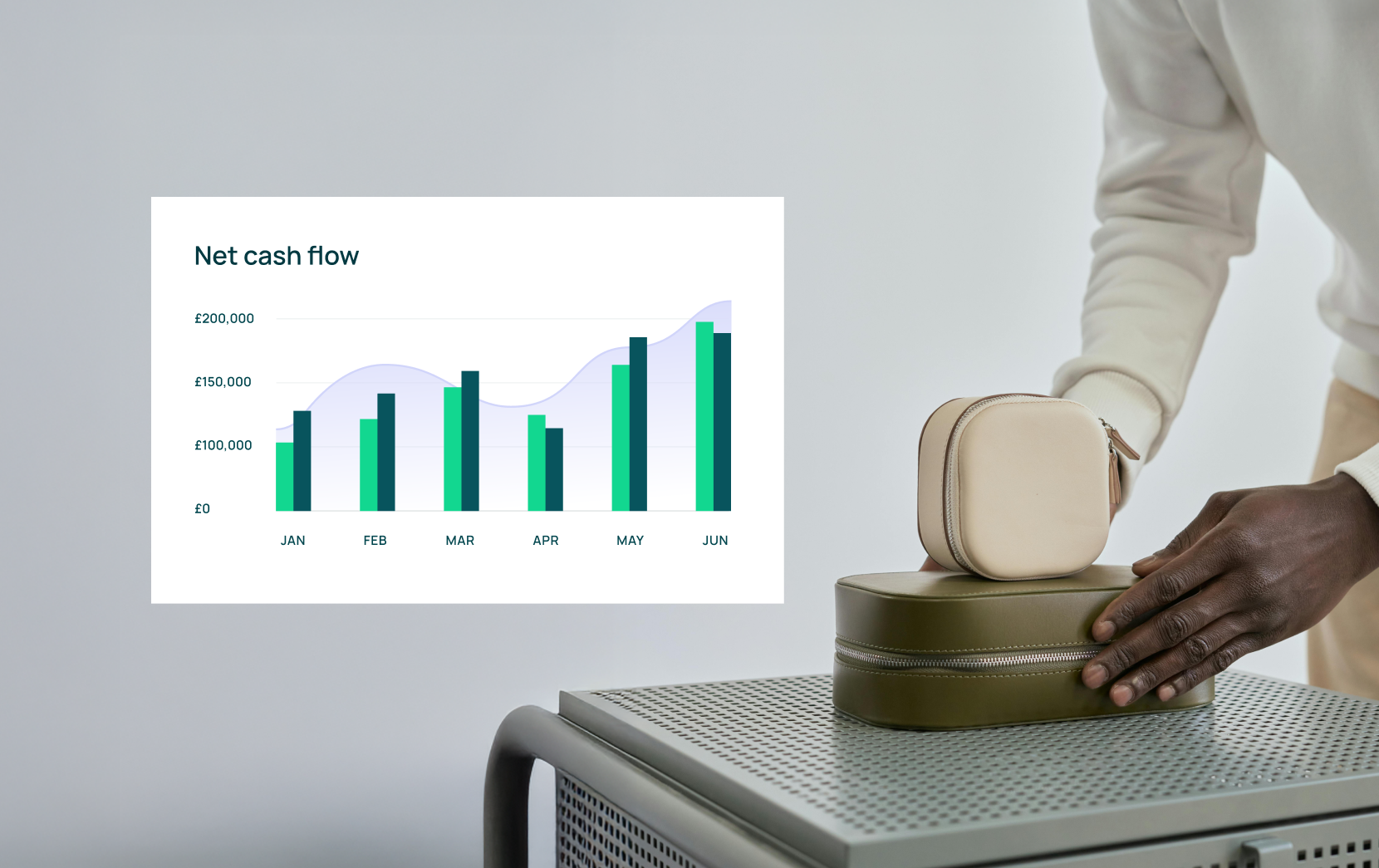
Every consumer brand operates within a version of the same constraint: cash goes out when you order stock, and cash comes back in when that stock sells and the invoice clears. The distance between those two moments is your cash conversion cycle.
For brands selling direct to consumer with fast payment settlement, that gap can be manageable. But for brands working with international manufacturers, selling into wholesale or retail channels, or operating on any kind of seasonal rhythm, the gap is often measured in months rather than weeks.
International manufacturers commonly require a deposit of around 30% upfront on large-volume orders, with the remainder due before shipment. Once you factor in production time and sea freight — which adds roughly four to six weeks compared to air — a brand placing a stock order in January may not see that inventory landed and ready to sell until March or April. The cash, however, left the business in January.
That timing mismatch is not a sign of poor management. Research from Novuna shows that 82% of UK SMEs have encountered cash flow difficulties, with late customer payments and seasonal shifts in sales the most common triggers. For consumer brands, where inventory is the single largest outgoing, the challenge is structural.
Why does cash flow get harder when a brand is growing?
This is one of the more counterintuitive realities of scaling a product business: growth does not ease the cash pressure, it typically increases it.
For a growing business, the working capital gap widens as revenue increases. Fast-growing companies often face the most acute cash pressure — raw material purchases are made weeks or months before production begins, finished goods may sit in a warehouse before a sale is made, and customer payment terms of 30, 60, or 90 days extend the gap further.
Put simply: the more you sell, the more stock you need to order, the more capital gets committed earlier, and the longer it sits before it converts back to cash. Experienced operators describe this as the risk of growing the company out of money — profitable on paper, strained in practice. This is the environment in which inventory finance earns its place.
Three Moments When Consumer Brands Turn to Inventory Finance
Most brands that use inventory finance do not arrive at it through financial difficulty. They arrive at it through a specific operational trigger — a moment where the cash cycle stretches beyond what retained earnings or existing facilities can bridge. Three triggers account for the majority of cases.
Long manufacturing lead times
The longer the gap between placing an order and receiving sellable stock, the more capital a brand needs to keep in motion simultaneously. A brand sourcing from Southeast or East Asia with a 10 to 14-week production run, followed by four to six weeks of sea freight, is committing capital roughly four to five months before it sees revenue from that stock.
That math gets difficult quickly. LittleBig Bikes — a children's bike brand working with manufacturers in China — described the problem plainly: the cash to buy stock needs to be committed five to six months before a penny comes back from a sale. Without a facility to bridge that gap, the only alternative is to understock and accept lost sales, or order smaller quantities more frequently and pay more per unit as a result.
Inventory finance solves this by aligning the financing to the production and shipping cycle rather than forcing the brand to fund it entirely from its own reserves.
Landing a major retail account
Winning a listing with a large retailer is a significant commercial milestone — and one that almost always creates an immediate cash flow problem. Large retailers typically require substantial stock volumes upfront to service their distribution network. They also pay on their own terms, which commonly run to net 60-120 days after inventory hits shelves. Meanwhile, the manufacturer wants payment within 30 days of dispatch.
This is the crunch point that catches many brands off guard. The opportunity is real and confirmed. The purchase order exists. But the capital required to fulfil it — to produce the stock, ship it, and wait for the retailer to pay — is not available from cash on hand.
Azio Beauty, a cosmetics brand sourcing from Korean suppliers, experienced this precisely. A 2.5-month production lead time combined with 30-to-60-day retail payment terms created a cash cycle of up to four months between spending and receiving payment. Their response was to use a revolving credit facility to fund stock commitments ahead of retail delivery windows — freeing their own cash to stay invested in marketing rather than sitting inside a purchase order.
UK research from Intuit QuickBooks found that small businesses with the highest volume of overdue invoices were more than 1.5 times more likely to report cash flow problems — a pattern that mirrors what brands experience in wholesale and retail, where payment terms are set by the buyer, not the seller.
Scaling fast with rising stock requirements
Fast growth creates a version of the same problem, but without a single trigger event. When a brand is growing quickly, stock requirements expand month on month. The cash generated by last month's sales is rarely enough to fund next month's orders, let alone the orders needed two months from now to account for lead times.
An e-commerce wellness brand growing at 1,300% year on year at the time of working with Triffin — described the situation directly: retained earnings simply could not keep pace with the inventory demand that growth required. The risk was not insolvency, it was missed sales due to being out of stock. Inventory finance allowed them to fund the stock piece of the growth plan without diverting cash away from the paid acquisition and marketing that was driving that growth in the first place.
The principle here applies more broadly. For cash flow strategies for scaling brands, the core tension is always the same: the business needs cash in two places at once — funding stock and funding the activities that sell it. Inventory finance is one of the tools that lets both happen simultaneously.
What Does Inventory Finance for Brands Actually Do?
How does inventory finance work for a consumer brand?
In its simplest form, inventory finance provides a brand with capital to purchase stock, which is then repaid as that stock sells and revenue arrives. Rather than the brand funding a production run entirely from its own cash, a lender advances the funds needed to place the order and the brand repays the facility over an agreed period aligned with its sales cycle.
The most flexible structure for consumer brands is a revolving credit facility — a standing line of credit that can be drawn down when stock orders are placed and repaid as sales come in, then drawn again for the next order cycle. Unlike a fixed loan, which provides a one-time lump sum and begins repayment immediately, a revolving facility moves with the rhythm of the business. Interest accrues only on what is drawn, and the facility remains available for the next order cycle once repaid.
This matters for brands with seasonal peaks, irregular production schedules, or multiple simultaneous stock commitments across different product lines.
Inventory finance vs trade finance vs working capital loans
These terms are often used interchangeably, but they address slightly different points in the same cash cycle.
Trade finance, in its traditional sense, refers to financing that sits at the point of the supplier transaction — funding the purchase order and paying the manufacturer directly. Inventory finance typically refers to funding secured against the value of existing or incoming stock. Working capital loans are broader, providing general-purpose capital that can be used for any short-term business need, including stock.
In practice, for most consumer brands, the distinction matters less than the structural question: does the facility align with your production and sales cycle? A facility that requires fixed monthly repayments regardless of whether stock has sold creates its own cash pressure. One that is tied to sell-through is a better fit for brands with variable or seasonal revenue patterns.
The Business Impact: What Inventory Finance Unlocks
Protecting your sales momentum
The most direct consequence of under-funding inventory is stockouts — and stockouts are expensive. Lost sales are the visible cost, but the less visible cost is what happens to customer relationships, retailer confidence, and brand momentum when products are unavailable.
For seasonal brands in particular, a missed stocking window can set back growth by a full year. Rippl, a motorcycle apparel brand, described this reality precisely: motorcycling is inherently seasonal, and missing a spring inventory window means waiting twelve months to recover. The velocity of sales in winter is simply not the same. The capital has to be in place before the season begins, not after it is already underway. Aligning inventory finance to seasonal cash flow planning is one of the more practical ways strong operators use financing as a protective measure rather than a reactive one.
Freeing up cash for marketing and operations
One of the less obvious benefits of inventory finance is what it does to the rest of the P&L. When a brand's own cash is tied up in stock, it is unavailable for the activities that generate the next wave of demand — paid acquisition, marketing spend, product development, and operational investment.
The brands that use inventory finance most effectively treat it as a separator. Stock gets funded by the facility. The brand's own cash funds growth activities. The two no longer compete for the same pool of capital, which means neither gets starved.
Adaptolatte, a DTC mushroom coffee brand, demonstrated this model well. By using a revolving credit facility to fund inventory, the founders were able to scale into new product lines without relying on equity or pulling cash from their marketing engine. When their previous credit arrangement was cut without warning, the model collapsed — which underscored just how structural the dependency on the facility had become.
Negotiating better supplier terms
A less commonly discussed benefit is the leverage that consistent, prompt payment gives a brand with its suppliers. When a brand can pay deposits and balances reliably and on time — because capital is available when needed — it builds the kind of relationship that eventually earns more favourable terms, shorter lead times, or priority production slots. Research from Equifax indicates that 82% of business failures are due to poor cash flow management — and one of the mechanisms through which cash flow problems compound is precisely this: strained supplier relationships, reduced credit limits, and a deterioration in the supply chain that makes operational planning harder over time. Inventory finance, used consistently, works in the opposite direction.
Is Inventory Finance Right for Your Brand?
Signs it could be a fit
Inventory finance tends to work well for consumer brands that share a few common characteristics. The product has a demonstrable sell-through rate and is not at significant risk of becoming obsolete before it sells. The brand has a clear view of its order cycles and production timelines, which makes repayment planning straightforward. And the cash flow gap — the distance between paying for stock and getting paid for it — is structural rather than a one-off problem.
The three triggers above are the clearest indicators: long manufacturing lead times, new retail listings with significant upfront stock requirements, or growth that is consistently outpacing the cash available to fund it. If any of these apply, inventory finance is worth understanding in detail.
When it might not be the answer
Inventory finance is a working capital tool, not a business model fix. If a brand is experiencing losses, struggling to sell existing stock, or has fundamental margin issues that make repayment uncertain, adding a financing facility creates pressure rather than relieving it.
It also requires operational discipline. The facility works when stock turns predictably and repayment aligns with sell-through. Brands with highly unpredictable demand, very long inventory holding periods, or products with high obsolescence risk need to model the repayment cycle carefully before committing to a facility.
The honest version of the question is not whether inventory finance is useful in theory, but whether the brand's stock moves reliably enough to make it practical.
Conclusion
Inventory finance for consumer brands is not a complex product. It solves a specific, structural problem: the gap between when you need to fund stock and when that stock converts back to cash. For brands with long manufacturing timelines, growing retail commitments, or rapid growth that is outpacing retained earnings, that gap is real and recurring.
The value is not just in bridging the gap. It is in what the gap being bridged makes possible — consistent stock availability, protected sales momentum, and working capital that can be invested in growth rather than locked inside a purchase order.
If inventory funding is a recurring pressure in your business, Triffin's inventory finance is built for consumer brands at exactly this stage — flexible, revolving, and designed to move with your production and sales cycle. You can apply in minutes and receive same-day pre-approval.


.png)