




For consumer brands selling into retail or wholesale, the gap between delivering an order and getting paid for it is one of the most persistent financial challenges there is. Revenue looks healthy. The pipeline is strong. But the cash position tells a different story.
Invoice finance exists to close that gap. It turns the value of unpaid invoices into working capital before the payment terms run out, giving brands access to cash that is technically already theirs. For the right businesses, at the right moment, it is a practical and well-matched funding tool. For others, it solves the wrong problem.
This post covers what invoice finance is, how it works in practice, the specific conditions under which it makes sense for consumer brands, and how it addresses the lumpy cashflow that comes with seasonal demand and extended retail payment terms.
What is invoice finance?
Invoice finance is a form of short-term funding in which a business uses its unpaid customer invoices as collateral to access cash ahead of payment. Rather than waiting 30, 60, or 90 days for a customer to settle, the business receives a percentage of the invoice value upfront from a finance provider. When the customer pays, the remaining balance is returned to the business, minus the provider's fees.
According to the British Business Bank's guide to invoice finance, lenders typically advance a percentage of invoice value quickly — often within 24 hours — using the debts owed by customers as security. The advance rate varies by provider and risk profile, but the British Business Bank notes that invoice finance can work alongside other lending facilities, making it a flexible addition to a broader funding structure.
The key feature that distinguishes it from a standard business loan is that repayment is tied to your customers paying their invoices, not to a fixed monthly schedule. That alignment with actual cash inflows is part of why it suits businesses with lumpy or timing-dependent revenue.
How does invoice finance work in practice?
The mechanics are straightforward. A consumer brand issues an invoice to a retail or wholesale customer. Rather than waiting for that payment to arrive, the brand submits the invoice to an invoice finance provider. The provider advances a portion of the invoice value — typically between 70% and 90% according to NetSuite guide to invoice financing — within 24 to 48 hours. When the customer eventually pays, the finance provider releases the remaining balance, minus their fees. Fees include a service or administration charge, plus interest on the amount advanced.
Invoice finance vs invoice factoring: What is the difference?
These two terms are often used interchangeably, but they are not the same. Invoice finance — specifically invoice discounting — allows a business to borrow against its invoices while retaining control of its own credit management. The customer relationship stays intact; the customer continues to pay the business directly.
Invoice factoring transfers the management of the sales ledger to the finance provider. The factor takes responsibility for collecting payment from the customer, which means the customer is aware of the arrangement. For consumer brands with carefully managed retail relationships, this distinction matters. Many brands prefer the confidentiality of invoice discounting for just this reason.
Why do consumer brands struggle with cashflow in the first place?
Cashflow problems in consumer brands are rarely a sign of a failing business. They are usually a structural feature of how the business operates. Understanding the root causes is useful before evaluating whether invoice finance is the right fix.
The mismatch between when you spend and when you get paid
Consumer brands that sell into retail or wholesale face a fundamental timing problem. They spend money on production and inventory long before an order is placed, and they receive payment for that order long after it has been delivered.
For brands sourcing from overseas, the cycle can stretch to four months or more. Production deposits are paid upfront. Manufacturing takes weeks. Shipping adds another month. The order arrives, gets delivered to the retailer, and an invoice is raised on 30 or 60-day terms. The cash from that sale may not land for 90 to 120 days after the money first went out.
Jonathan, founder of Azio Beauty, described this when talking about his experience scaling the brand into retail. Moving into retail meant accepting lower margins per unit alongside longer payment terms — 30 to 60 days from Korean suppliers with no credit terms, combined with a 2.5-month production lead time. The result was a cash cycle of up to four months between the initial spend and the incoming payment. For Azio, external capital was not a last resort. It was structurally required to grow at pace.
Seasonal demand and lumpy cashflow
Seasonality creates a version of this timing problem that recurs on a predictable cycle. Consumer brands in fashion, beauty, gifting, and outdoor categories often see demand concentrated in specific windows, but inventory investment has to happen months in advance.
As the Lumen Learning retail management resource on seasonality and cashflow explains, businesses with seasonal revenue still carry full-year operating costs. The timing of inventory purchases relative to when the product actually sells determines whether the business has cash available or not.
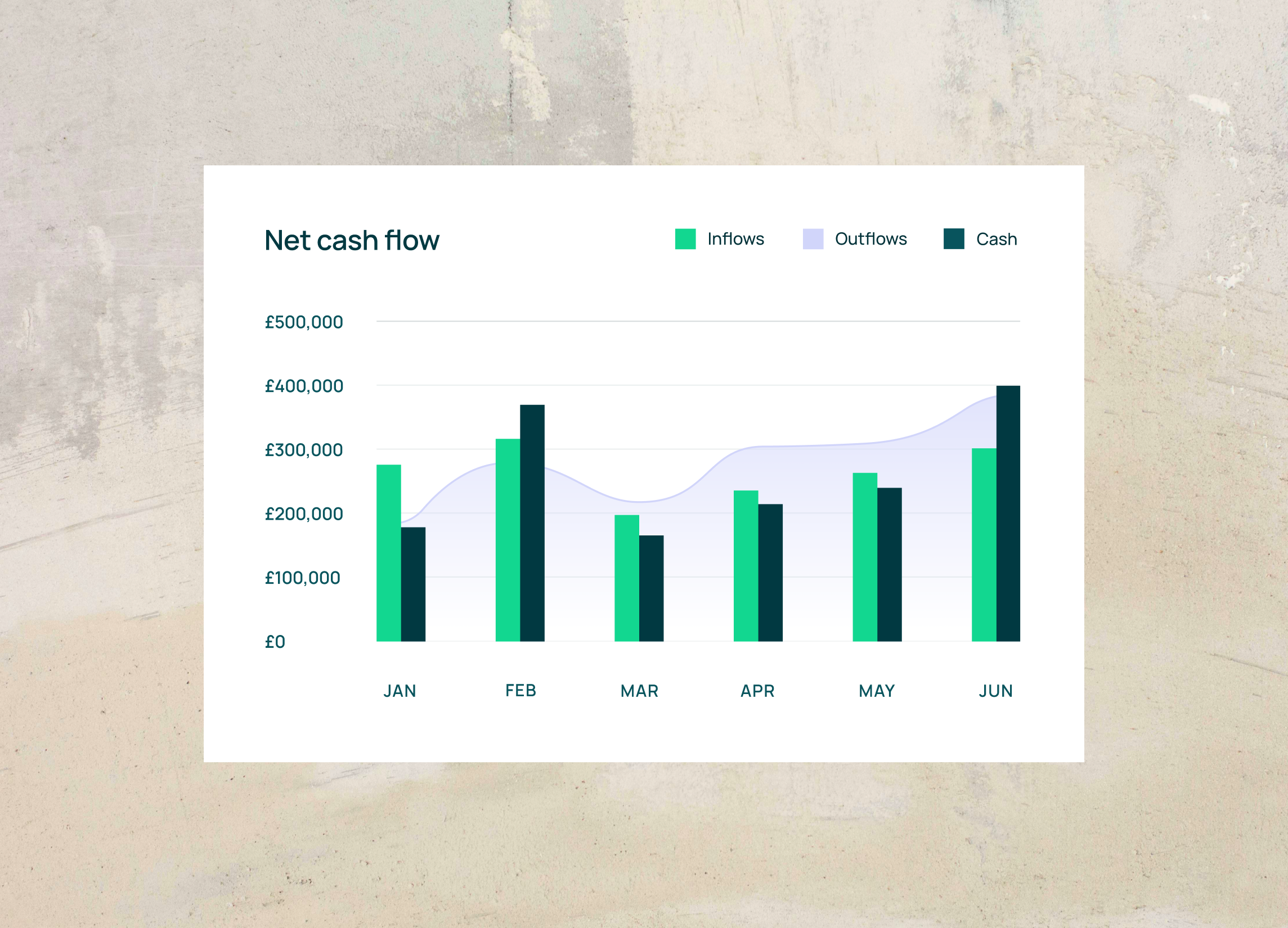
This is what makes cashflow in seasonal businesses "lumpy" rather than consistently tight. There are periods of strong inflow and periods of near-zero revenue, while costs keep running. The cash required to fund the next selling season leaves the account months before that season's revenue arrives. Brands that do not plan for this gap in advance often find themselves underfunded at the worst possible moment.
Nick, founder of Rippl Impact Gear (a seasonal motorcycle apparel brand), described the consequence bluntly: missing a spring stocking window means waiting a full year to recover. The velocity of seasonal sales is difficult to replicate out of season, so the capital needs to be in place before the season opens, not once it is already underway.
The late payment problem in the UK
Even when payment terms are agreed in writing, they are not always honoured. Research from QuickBooks published in 2025 found that three in five UK small businesses were grappling with unpaid invoices, with an average of £21,400 owed in late payments. More than half of those businesses had invoices overdue by 30 days or more.
Analysis by FreeAgent, covering invoices sent between September 2024 and August 2025, found that nearly two-thirds of all SME invoices were paid late. The British Business Bank estimates that £23.4 billion in late invoices is owed to UK businesses at any given time.
For consumer brands with tight working capital, even a single late payment from a major retail account can have a material knock-on effect. Invoice finance does not eliminate the late payment problem, but it can significantly reduce exposure to it by decoupling a brand's cashflow from its customers' payment behaviour.
When does invoice finance make sense for a consumer brand?
Invoice finance is not a universal solution. It works well in specific operating conditions and less well in others. The businesses that use it most effectively understand which situation they are in before they apply.
You are selling into retail or wholesale on payment terms
Invoice finance is designed for B2B transactions where invoices are raised with payment terms attached. It does not apply to point-of-sale consumer transactions. Xero's guide to invoice financing for UK businesses notes that it is particularly relevant when there is a large corporate buyer involved, where payment tends to be slow and the commercial stakes of taking on the contract are already high.
Consumer brands moving from DTC into wholesale or retail distribution frequently encounter this for the first time. The order volumes are larger, the margins are lower, and the payment terms are longer. The combination creates a working capital need that retained earnings or credit cards cannot easily absorb.
Your cashflow is lumpy, not consistently tight
Invoice finance works well when cashflow problems are timing-related rather than structural. If a business is consistently loss-making, invoice finance is not the right tool. But if the business is profitable and simply waiting on payment, accessing a percentage of that value early is a logical step.
The British Business Bank identifies two scenarios where invoice finance is particularly relevant: businesses managing seasonal periods when revenues are lower than usual, and businesses needing funds to stock up on inventory before a peak. Both describe common situations for consumer brands.
The business-level signal to watch for is a pattern where cash position drops sharply at predictable points in the year, linked to large inventory outflows or concentrated invoice issuance, and recovers when payment arrives. That pattern is addressable with invoice finance in a way that a persistent cashflow deficit is not.
How invoice finance smooths out lumpy cashflow
The practical value of invoice finance for consumer brands is not just that it provides cash. It is that it provides cash at the right moment in the operating cycle.
Turning a 60-day wait into working capital today
When a brand issues a wholesale invoice on 60-day terms and finances it, the majority of that invoice value becomes available within 24 to 48 hours. That capital can immediately be redirected: paying a supplier deposit on the next production run, funding a marketing campaign ahead of a seasonal peak, or simply covering operating costs without touching reserves.
This matters most when the brand is growing. Growth in a product business is almost always cash-negative in the short term. More orders require more inventory. More inventory requires capital before the revenue arrives. Without a mechanism to accelerate the cashflow cycle, brands either slow growth to match their cash position or take on equity they did not need to give away. Invoice finance offers a third option: access to capital that is already earned, just not yet collected.
Businesses that integrate this approach into their regular planning — rather than treating it as emergency funding — tend to use it most effectively. It becomes a structural tool within the cashflow cycle, not a response to a crisis.
Reinvesting freed-up cash into growth
The secondary effect of invoice finance is what it unlocks downstream. When working capital is no longer tied up waiting on retail payment terms, it can be redeployed into the activities that drive growth.
For consumer brands, this typically means marketing and stock. Azio Beauty used their revolving credit facility — which included invoice finance — to buy more inventory and commit to more retail supply. That freed up their own cash to reinvest into marketing. The two pillars of growth — stock and acquisition — could operate in parallel rather than competing for the same limited pool of capital.
This is the compounding benefit that tends not to appear in basic comparisons of invoice finance cost versus alternatives. The cost of the facility is visible. The growth unlocked by having capital available at the right time is harder to quantify, but often more significant.
What should consumer brands watch out for?
Invoice finance is a useful tool. It is not a free one, and it is not the right fit in every scenario.
Cost vs benefit: When does it make sense financially?
The fees associated with invoice finance can vary considerably depending on the provider, the invoice size, and the credit quality of the debtor. There are typically two components: a service or administration fee, and an interest charge on the amount advanced. NetSuite's analysis notes that the compounding effect of weekly factor fees can result in a meaningful annual cost if invoices take a long time to be settled.
The right question is not whether invoice finance costs money, but whether the return on the capital outweighs the cost. For a brand using the advanced funds to place an inventory order that generates a 40% gross margin, the maths usually works. For a brand using it to cover a recurring operational shortfall without a clear path to improved cashflow, the cost accumulates without a commensurate return.
The strongest brands evaluate invoice finance the same way they evaluate any working capital tool: in relation to what the capital will do, not in isolation.
Is invoice finance a long-term tool or a short-term fix?
Xero's guidance on invoice finance is clear on this point: it is a better shorter-term solution than a long-term loan, because repayment is tied to invoice settlement rather than a fixed schedule. But it also cautions against using it as a cover for underlying cashflow problems that need addressing at source.
For consumer brands, the most durable use of invoice finance is as one component within a broader working capital strategy — used during growth phases, seasonal peaks, or transitions into new channels, rather than as a permanent substitute for positive cashflow management.
How should consumer brands evaluate an invoice finance provider?
What to look for beyond the headline advance rate
The advance rate is the starting point, not the full picture. Xero recommends evaluating providers on several dimensions: the fee structure and whether it is transparent, the model (factoring vs discounting), what happens if a debtor does not pay, and how selective the facility allows the brand to be.
Selective invoice finance — the ability to finance individual invoices rather than the whole ledger — is important for brands that want flexibility. Whole-ledger arrangements can provide larger facilities but require more ongoing commitment. Understanding which structure suits the business's trading patterns is a more useful frame than comparing headline rates alone.
The British Business Bank's invoice finance checklist offers a useful starting framework for businesses assessing whether they are ready to apply and what to consider before entering an agreement.
Speed of funding, integration with accounting software, and clarity of contract terms are also worth weighing. The operational experience of using the facility matters as much as the economics, particularly for leaner teams where finance processes need to be manageable day to day.
Invoice financing made simple with Triffin
Invoice finance is a well-matched tool for consumer brands that issue B2B invoices on payment terms and need to close the gap between delivery and payment. It addresses lumpy cashflow directly, it scales with trading volume, and it does not require the business to give up equity or commit to a fixed repayment schedule that ignores seasonal realities.
It works best when the underlying business is healthy and the cashflow problem is timing-related. It works less well as a response to structural underperformance.
For consumer brands actively growing into retail and wholesale channels, where large orders and long payment terms are the norm, having access to invoice finance as part of a broader working capital facility can make the difference between capitalising on growth and being constrained by it.
Triffin's invoice finance facility is built specifically for consumer brands in this position, offering instant payment on retail and wholesale invoices alongside flexible repayment terms. It sits within a revolving credit facility that combines invoice finance with inventory funding in a single structure, designed for brands that need working capital to move at the pace their growth requires.
If cashflow timing is becoming a constraint on what your brand can do next, it is worth understanding whether invoice finance is the right tool for that moment.

.png)